Industrial RAG: How to Ground AI in Real Plant Data
Generic RAG works on documents. Plant data is not documents. Here is why retrieval-augmented generation breaks on the factory floor, and the architecture that makes it work.
An unplanned shutdown or a stoppage at a production site is expensive twice over: once in lost production, and again in the money it takes to recover. That is why the work that follows an incident matters so much. Management calls for an RCA, a root cause analysis, to identify what actually went wrong and to make sure it does not happen again. Doing that properly means going back through the data: the historical trends, the alarm sequence, the state of the equipment in the minutes before the stop. The goal is to find the first action in the chain, the one that cascaded into the failure at the end.
Industrial RAG is what happens when you make that operational data readable by an AI system. It lets an engineer or a manager ask, in plain language, "why did compressor 3 trip last night?" and get an answer grounded in the actual trends, alarms, and maintenance history rather than a plausible guess. The idea is simple. The execution is where almost every project I have seen goes wrong, because the standard RAG recipe was designed for documents, and a plant does not produce documents. It produces millions of timestamped numbers with names like FCV100.PV.
The short version: you cannot embed your way out of this. Industrial RAG works when you stop treating plant data as text to be searched and start treating it as structured data to be queried, with a semantic layer that tells the model what the tags actually mean. Everything else is detail.
RAG in one paragraph
Retrieval-augmented generation is the technique of fetching relevant information at question time and putting it into the model's context, so the answer is grounded in your data rather than in whatever the model absorbed during training. In the usual implementation, documents are split into chunks, each chunk is converted into a vector embedding, and a question retrieves the chunks whose embeddings sit closest to it. That approach works remarkably well on prose: policies, manuals, support tickets, contracts.
It works because prose carries its own meaning. A paragraph about vacation policy looks, mathematically, like a question about vacation policy. That property is exactly what plant data lacks.
Why plant data breaks the standard recipe
Four things make operational data different, and each one breaks a different assumption in the default RAG pipeline.
Time-series values carry no semantic content. A reading of 74.2 means nothing on its own. It is not similar to any question, in any embedding space, in any useful way. Chunking a year of process values and embedding them produces a vector database full of noise. The retrieval step returns something, because retrieval always returns something, and that is precisely the danger.
Tag names are codes, not language. FCV100.PV is obvious to an engineer who knows the plant: the process value of flow control valve 100. To an embedding model it is a meaningless string. Ask "what was the flow on the transfer line," and semantic search has no path from your words to that tag. This single gap is the most common reason an industrial RAG demo works on ten hand-picked tags and collapses on ten thousand real ones.
The questions are temporal and causal, not lookup. "Why did compressor 3 trip last night" is not a search query. It requires resolving "last night" to an actual time window, identifying which asset and which unit, pulling multiple correlated tags across that window, ordering the alarm sequence, and only then reasoning about cause. Standard retrieval does none of that. It finds text that looks like the question.
Being confidently wrong is not an equivalent risk here. If a chatbot hallucinates a summary of a policy document, you get an inconvenience. If a system tells a process engineer that a vessel held at 4 degrees when it actually excursioned to 9, in a regulated plant, you have a very different kind of problem. Eighteen years in safety-critical control systems left me with one instinct above all others: the failure mode determines the design. Industrial RAG has to be built so that a number in the answer can always be traced back to a tag and a timestamp.
The architecture that actually works
The working pattern is not one retrieval path. It is a router in front of several, because different questions need genuinely different machinery.
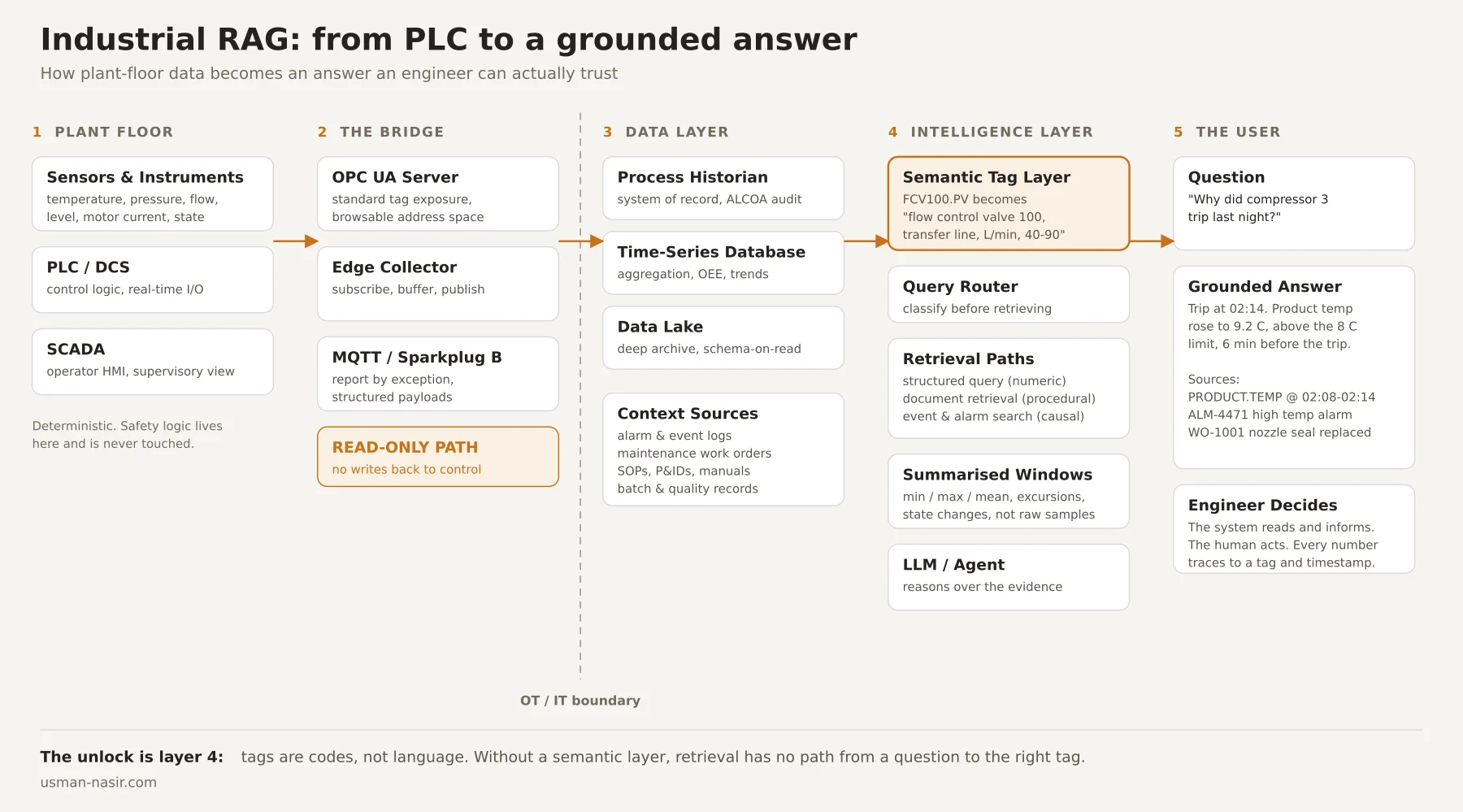
1. A queryable store, first. None of this is possible while the data is trapped in the PLC or locked in a historian nobody can reach. The data has to be somewhere you can query it, which is the whole subject of my OT to cloud architecture guide, and where you put it (historian, time-series database, data lake) is the decision I worked through in historian vs time-series database vs data lake. Industrial RAG is a layer on top of that foundation. Skip the foundation and nothing above it holds.
2. A semantic layer over the tags. This is the unlock, and it is the part teams skip because it is unglamorous. Build a dictionary that maps every tag to what it actually is: the asset it belongs to, the process it serves, its engineering units, its normal operating range, its alarm limits, and a plain-language description. FCV100.PV becomes "flow control valve 100, process value, product transfer line, litres per minute, normal range 40 to 90." Now a question about "flow on the transfer line" has a path to the right tag. This dictionary is also the thing that makes answers explainable, because the model can name the asset instead of reciting a code.
3. A query router. Classify the incoming question before retrieving anything. Numeric and temporal questions ("what was the average fill temperature during Tuesday's night shift") become structured queries against the time-series store, generated from the semantic layer rather than from vector search. Procedural and contextual questions ("what is the CIP procedure for the filler") go to document retrieval over SOPs, manuals, and P&IDs, where classic RAG genuinely shines. Diagnostic questions ("why did compressor 3 trip") need both, plus the event log.
4. Summarised windows instead of raw samples. A model cannot reason over 86,400 samples, and it does not need to. Convert a time window into a compact factual summary: minimum, maximum, mean, standard deviation, state changes, threshold excursions with their timestamps, and rate of change. Those summaries are short, they are textual, and they are the thing you put in the context window. This is the step that turns unusable data into usable evidence.
5. Alarms and events as the semantic bridge. Alarm and event logs are the most underused asset in the plant for this purpose. They are already timestamped, already textual, already meaningful, and they map directly onto the causal questions people actually ask. An alarm sequence is a narrative of what happened, in order. Retrieve on that, then pull the supporting numbers around it.
6. Context from the systems next door. Maintenance work orders, shift handover notes, quality records, and batch records are where the human explanation usually lives. A trip at 02:14 makes far more sense next to a work order that replaced a nozzle seal that morning. Joining sensor data to that context is exactly what a historian cannot do on its own, and it is one of the strongest arguments for landing plant data somewhere joinable.
7. Citations, always. Every number in an answer should carry its tag and timestamp, and every claim its source document. Not as a nice-to-have, but as the mechanism that lets an engineer verify in five seconds instead of trusting blindly. In a regulated environment it is also what makes the output defensible at all.
Where it goes wrong
Three patterns show up repeatedly.
The embedding-everything approach. A team vectorises the entire historian, gets a demo that answers three questions impressively, and then discovers that the system confidently invents values for anything outside those three. The root cause is always the same: retrieval was asked to do a job that belongs to a query engine.
The ten-tag demo. Everything works beautifully on a curated handful of tags with hand-written descriptions. Then it meets a real plant with thousands of tags, inconsistent naming across three generations of equipment, and no dictionary. The demo does not scale because the semantic layer was never built, only faked.
The missing time discipline. "Last night" means different things to the day shift and the night shift, and "compressor 3" might be called something else in the historian than on the P&ID. Ambiguity in time and asset resolution produces answers that are precisely wrong, which is worse than obviously wrong, because nobody catches it.
What good looks like
Judge an industrial RAG system on questions it has never seen, not on the demo set. The measures that matter in practice are whether the numbers in the answer match the source data exactly, whether the system says "I do not have that" instead of inventing when a tag is missing or the window is empty, whether time ranges and asset names are resolved correctly, and whether every claim is traceable. Speed matters far less than any of those. An engineer will happily wait twenty seconds for an answer they can trust and act on.
The other half of good is knowing where the human sits. These systems should read, never write. They inform the person who decides. That boundary is the same one I keep coming back to in how the AI agent loop actually works: give the system real autonomy in gathering and reasoning, and keep the human exactly where the accountability lives.
The bottom line
Industrial RAG is not a harder version of document RAG. It is a different problem wearing the same name. The data is numeric, the identifiers are codes, the questions are temporal and causal, and the cost of a confident error is measured in production or safety rather than embarrassment.
Get the foundation right first, then build the semantic layer that turns tags into meaning, then route questions to the machinery that can actually answer them. Do that and the promise holds: an engineer asks why compressor 3 tripped, and gets an answer grounded in what really happened, with the receipts attached. Skip it and you get a system that is fluent, fast, and quietly wrong.
Written by Usman Nasir — control systems engineer, Stockholm.